Why Bulk Laptop Buyback Belongs in Your Refresh Strategy?

Growth solves one set of problems and quietly creates another. As teams expand and hardware refresh cycles speed up, laptops start piling up. Some were replaced during upgrades. Some belonged to employees who moved on. Others are kept “just in case.”
Buying laptops is rarely the issue. Most growing companies have procurement figured out. The blind spot usually shows up at the other end of the lifecycle, i.e., when devices are no longer in active use. Without a clear recovery plan, they lose value month after month. They take up space, and in some cases, they even introduce avoidable data risk.
That’s where bulk laptop buyback starts to make sense. It’s not about offloading old equipment for the sake of it. It’s about being intentional with your assets. It’s also about recovering value before depreciation gets to it.
This approach reduces upgrade costs instead of forcing companies to absorb them entirely. It positions hardware as part of an ongoing cycle rather than a one-time purchase. For growing companies, such a shift isn’t dramatic; it’s disciplined, which in turn helps in scaling.
What Is Bulk Laptop Buyback?
Bulk laptop buyback is a process where companies sell their unused or outdated laptops in large quantities to a third-party vendor or service. This allows organizations to recover some of the initial investment by getting cash or credit for these devices. By doing so, they not only free up valuable storage space but also mitigate data security risks associated with storing old devices.
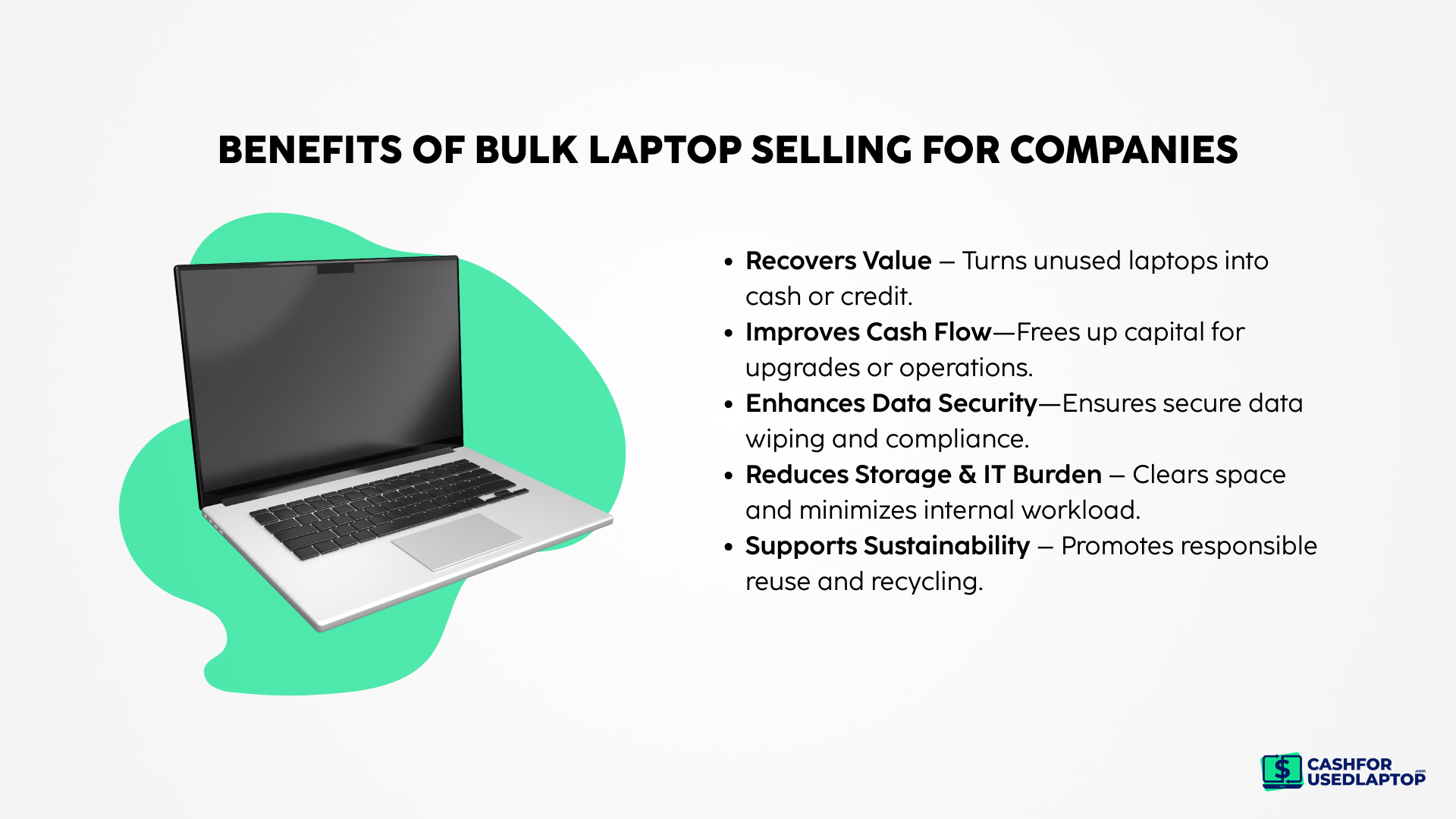
Asset evaluation, quantity and condition-based pricing, secure data wiping, organized pickup, and structured payment are all common components of a bulk buyback scheme. The procedure is intended for businesses that oversee dozens or even hundreds of devices at once.
Businesses turn idle equipment into recovered value instead of letting laptops deteriorate in storage. They appropriately handle data security and lessen internal workload at the same time.
To put it simply, bulk laptop buyback converts excess hardware into capital without disrupting the workflow or taxing internal IT resources.
Why Growing Companies Should Care
As organizations scale, hardware decisions carry financial and operational weight. Bulk buyback helps ensure surplus devices don’t quietly undermine efficiency.
1. IT Assets Depreciate Faster Than You Think
Technology doesn’t hold value for long. A laptop that’s relevant today can lose a noticeable portion of its resale value within a year. When devices sit in storage after an upgrade cycle, depreciation continues quietly in the background.
For growing companies managing hardware at scale, that loss compounds. Industry analysts like IDC note that business laptops lose 25% of their resale value within the first 24–36 months, making timing critical for recovery.
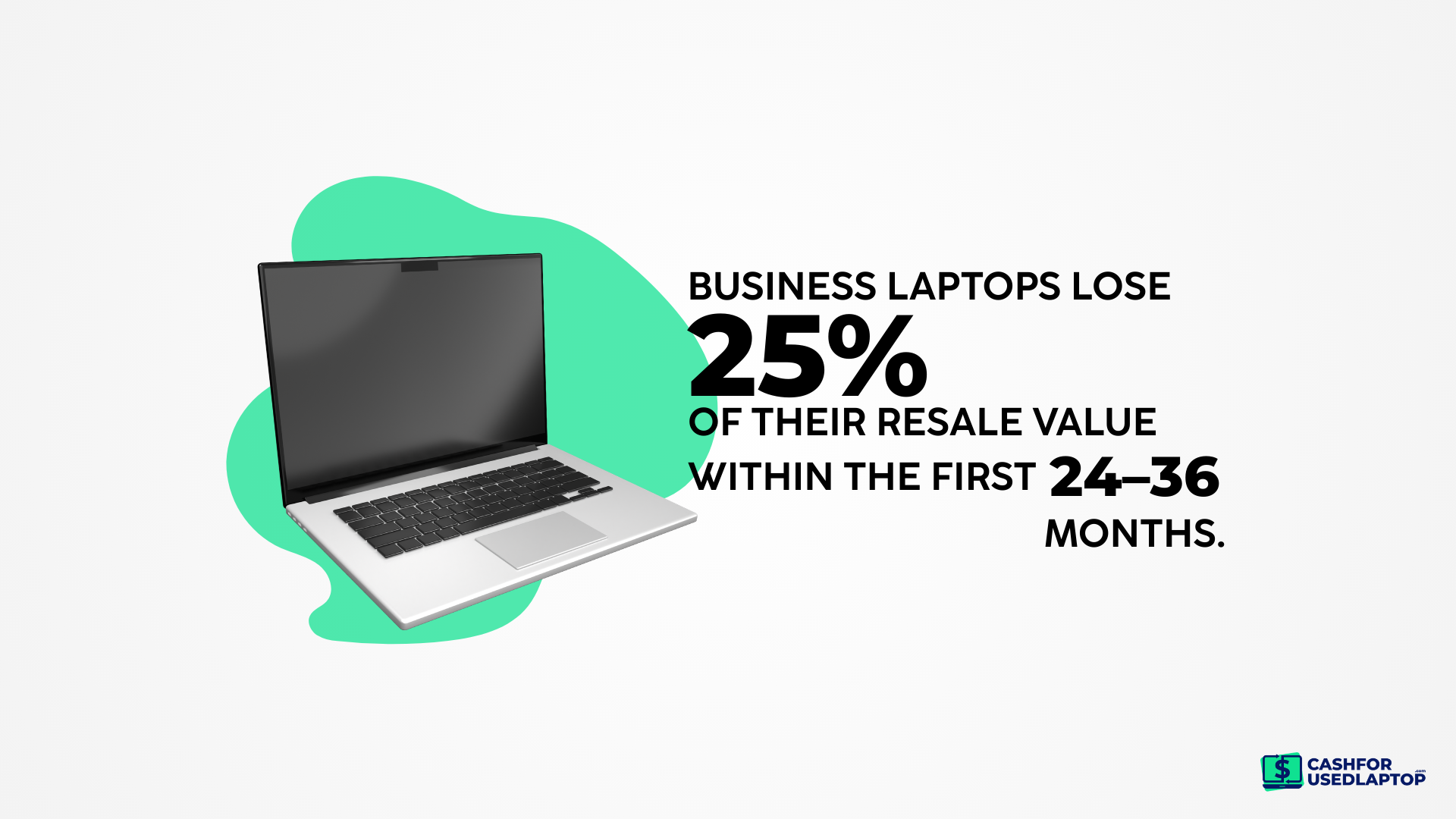
Bulk buyback allows you to recover value before it erodes further. Instead of idle inventory, you create working capital.
2. It Reduces Net Upgrade Costs
Most businesses set aside money for new hardware. Fewer make strategic plans to reclaim assets. Upgrade prices become more predictable when you incorporate bulk buyback into your refresh cycle. New acquisitions are offset by recovered value. From full replacement cost to net investment, the whole expenditure changes.
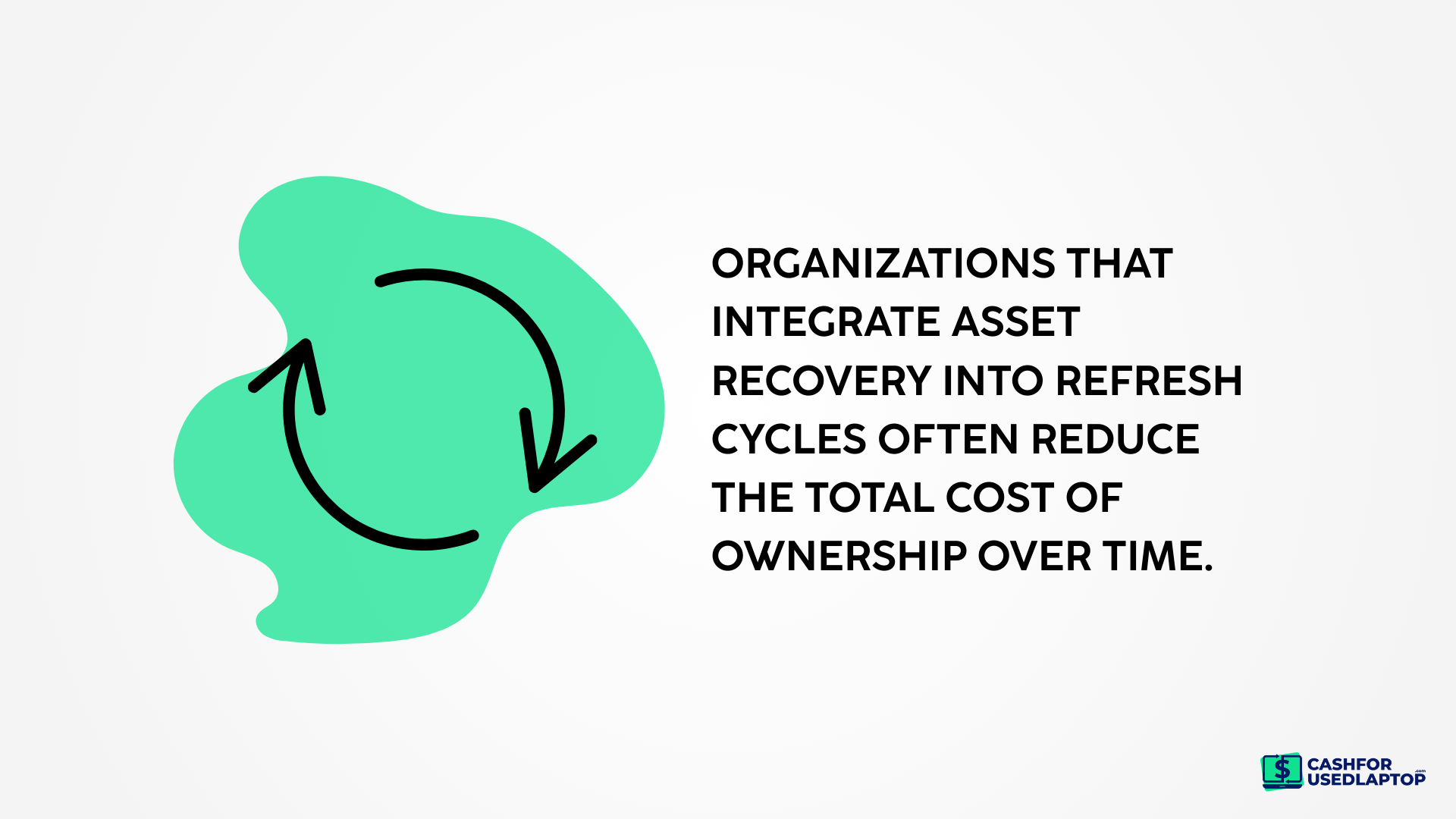
That difference adds up over time, particularly for businesses that are rapidly expanding their workforce. Research from Gartner suggests that organizations that integrate asset recovery into refresh cycles often reduce the total cost of ownership over time.
3. It Simplifies IT Operations
There is operational friction due to surplus gadgets. They need administrative supervision, storage space, tracking, and secure wiping.
That work is centralized through a systematic bulk buyback procedure. Devices undergo coordinated evaluation, collection, and processing. The IT staff can devote more effort to servicing live systems and less time to maintaining retired hardware.
When disposal is not improvised, operational clarity improves.
4. It Strengthens Data Security and Compliance
Unused laptops are not harmless. They pose a risk if they include private client or business information.
Professional bulk buyback procedures include documentation and the confirmation of data deletion. This lowers exposure and creates a record of proper management, which is particularly crucial for businesses with contractual or regulatory commitments.
Just because a device leaves a person’s desk doesn’t mean the security will stop. Industry security guidance consistently identifies improper device disposal as a preventable source of data exposure, reinforcing the need for certified data erasure and documentation.
5. It Supports Sustainability Goals
The problem of e-waste is getting worse due to discarded devices. Reselling or refurbishing devices to extend their lifespan lowers the need for needless trash and production. Reports from the United Nations Global E-waste Monitor continue to highlight the rapid growth of electronic waste worldwide
Bulk buyback provides quantifiable sustainability initiatives for businesses monitoring environmental parameters or establishing ESG commitments. Instead of ending up in landfills, it repurposes extra hardware.
Responsible asset management is a component of responsible growth.
Bulk Buyback vs Storing Surplus Devices
Here’s a quick comparison between bulk buyback and storing surplus devices:
|
Factor |
Storing Surplus Laptops |
Bulk Laptop Buyback |
|
Asset Value |
Continues to depreciate over time |
Value recovered before major depreciation |
|
IT Workload |
Ongoing tracking and storage management |
Structured process with minimal internal effort |
|
Data Risk |
Potential exposure if devices aren’t wiped properly |
Certified data sanitization included |
|
Storage Costs |
Requires physical space and inventory oversight |
Devices removed from internal storage |
|
Budget Impact |
No capital recovery |
Generates recoverable funds for reinvestment |
|
Sustainability |
Risk of eventual disposal waste |
Supports refurbishment and reuse |
How the Bulk Buyback Process Typically Works
Bulk laptop buyback is predictable and structured when handled well. The objective is to ensure fair value and safe handling while minimizing friction for your internal staff.
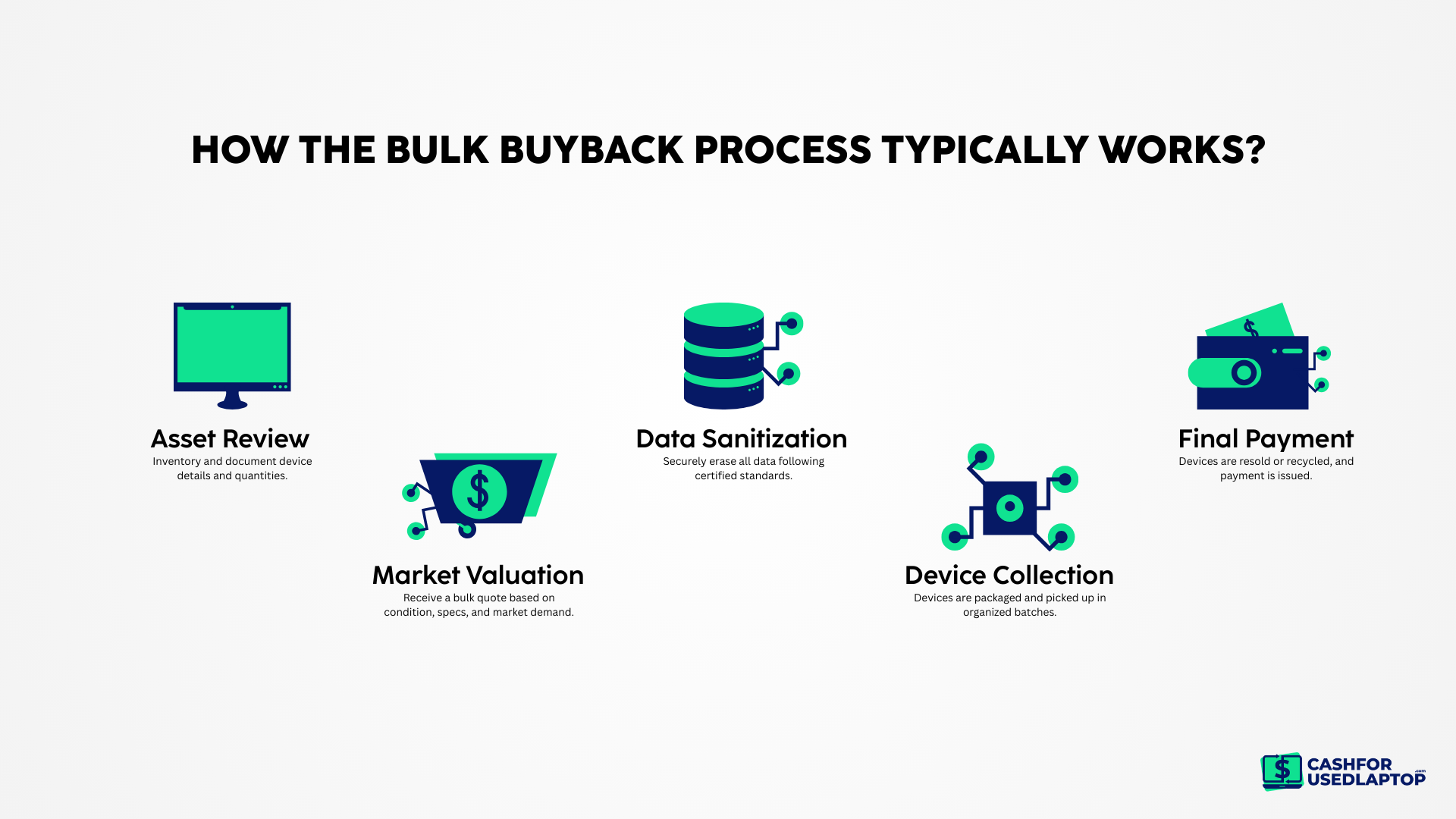
1. Asset Audit
The process begins with clarity. You identify which devices are being retired and document key details: model numbers, processor specs, storage capacity, physical condition, and quantity. A proper audit does two things. First, it prevents under- or over-valuation. Second, it speeds up quoting and collection. The more accurate the inventory, the smoother the transaction.
For growing companies with distributed teams, this step may also involve consolidating devices from multiple departments or locations before evaluation.
2. Valuation
Once the inventory is reviewed, the buyer provides a fleet-based quote. Pricing is influenced by current resale demand, device age, brand reputation, configuration, and cosmetic condition. In bulk transactions, valuation reflects overall volume efficiency rather than individual retail pricing.
This stage is where timing matters. Devices typically hold more value closer to their refresh cycle. Waiting too long can reduce recoverable returns.
3. Data Sanitization
Before devices leave your control, data must be securely erased. Professional buyback partners follow certified data destruction standards and often provide documentation confirming the process. This ensures compliance with internal policies, contractual obligations, or regulatory requirements.
Data security should be procedural, not improvised. A structured wiping process eliminates lingering exposure risk.
4. Collection & Logistics
Bulk transactions are coordinated to minimize operational disruption. Instead of shipping devices individually, laptops are collected in consolidated batches. Packaging, transportation, and handling are managed to protect equipment during transit.
For IT teams, this means fewer manual tasks and less time spent managing retired hardware.
5. Payment & Asset Repurposing
After inspection and processing, devices are either refurbished for resale, remarketed into secondary markets, or responsibly recycled if they are no longer viable. Payment is issued according to agreed terms, completing the recovery cycle.
At this stage, surplus hardware is no longer a storage liability. It has either been converted into capital or reintegrated into the technology ecosystem responsibly.
When Bulk Buyback Makes the Most Sense
Bulk laptop buyback isn’t something companies think about daily. It becomes relevant at specific inflection points, usually during growth or transition.
• During Rapid Hiring or Scaling

Hardware refresh cycles follow rapid headcount growth. The purpose of replacing older devices is to support new software requirements or standardize performance. Bulk buyback lets you keep your fleet up to date while recovering value, rather than retaining phased-out computers.
• During Scheduled IT Refresh Cycles

Industry procurement trends show that companies operating on three- to four-year refresh cycles are often positioned to recover the strongest resale value within those windows. It is still possible to incorporate recovery into the replacement budget and devices still have resale value.
• During Office Consolidation or Hybrid Shifts

Surplus equipment is frequently discovered through mergers, relocations, or switches to hybrid work. Organizations can lower logistical overhead by turning underutilized equipment into capital rather than transferring it and keeping it.
• When Storage Starts Becoming a Problem

If retired laptops are accumulating in cabinets or storage rooms, that’s a signal. Idle hardware ties up both space and value.
Conclusion
Bulk laptop buyback isn’t about clearing out old devices for the sake of it. It’s about recognizing that hardware has a lifecycle and managing that lifecycle intentionally.
Growing organizations that operate with this mindset tend to see the difference over time. Balance sheets stay cleaner because assets aren’t sitting idle. Security practices remain tighter because devices aren’t forgotten in storage. IT budgets become more predictable because recovery offsets replacement.
Most importantly, hardware stops quietly losing value in the background. It becomes part of a controlled system, one that supports growth instead of complicating it.
If you’re planning an upgrade, consolidating equipment, or sitting on unused hardware, now is the time to act. Reach out to Cash For Used Laptop to request a bulk evaluation and see how much value you can recover from your surplus devices.